:
There seems to be a lot of confusion surrounding this colour group. I have come across some people who would like to think brassy backs are furnace; some say polecats are brassy backs, and sometimes that furnace are polecats. These are often given without proof for their claims, or they use standards from other countries to prove their point.
Now, to be fair on them, there really isn’t much information out there about this colour group, so I’m going to break it down for you, from the genotype of these colours to the variations among this group, and more.
I am going to give you an in-depth, illustrated guide to the brassy back, furnace, and polecat family.
Please note that none of the photos used herein are to be used as ideals; all of them have colour faults of some form.
A basic description of this family
This colour group is among the most striking of varieties, and I’m only partially being biased, as these are easily my favourite varieties.
Both males and females are equally stunning, but surprisingly different. Although this article is going to be mostly focusing on the black and “red” (orange, yellow, brassy, red, etc.) side of this family, it must be remembered that there are many variations, such as the addition of the blue gene. These then make the blue brassy back, blue furnace, and blue polecat, as well as the silver gene, which would make the “red” colour white. The variations within this family are almost endless.
Males: Black or dark birds with “brassy” colour usually on the shoulders, back, saddle, wing, depending on the exact variety.
Female: Black or dark bird with fawn or salmon breast, and black or dark intermingled with fawn, salmon, or “brown” on the back and cushion as well as usually the wings.
This article is based on the New Zealand Poultry Standards 2013 and is not necessarily accurate for other countries, so if you’re from another country please check this information with that of the relevant standard. The genetic information is still the same.
The brassy back
This is definitely my favourite of the three varieties, also happens to be the one I breed.
I find they are a nice mix of black and “brown/brassy”. They are the only variety in this group that is crow-winged, meaning the male’s wing bay (secondaries) is the same colour as his body, in this case black.
The following is quoted from the New Zealand Poultry Standards book, the 3rd edition (2013):
Old English Game Bantam: Male; “black, with brass colour on back, wing butts, hackles and hangers. No wing bay colour allowed, clear hackles and hangers allowed.”
Female: “pale brown to dark brown with black neck hackle, tail, wing flights. Brown or brassy streaks allowed in the neck hackle, some speckles and/or lacing allowed on breast and belly.”
Pekin Bantam: Male; “black or dark glossy hackle and body. Brassy yellow or fawn on shoulders, wings and back. Foot feathers black intermingled with brassy yellow or fawn.”
Female: “body soft black tinged with brown, often with light shafts in feathers. May have fawn breast intermingled with black. Foot feathers soft black intermingled with brown or fawn.”
So you can see from the description above that the brassy back male must have colour on his back and wing bows, and his wing bay must be black; he can have colour in his neck, saddle and hangers, but that does not define the colour and is only in the OEGB standard.
The female, however, has a fawn breast in any breed, and is otherwise a mix of black and brown.
This is how we will identify a brassy back from the other colours.
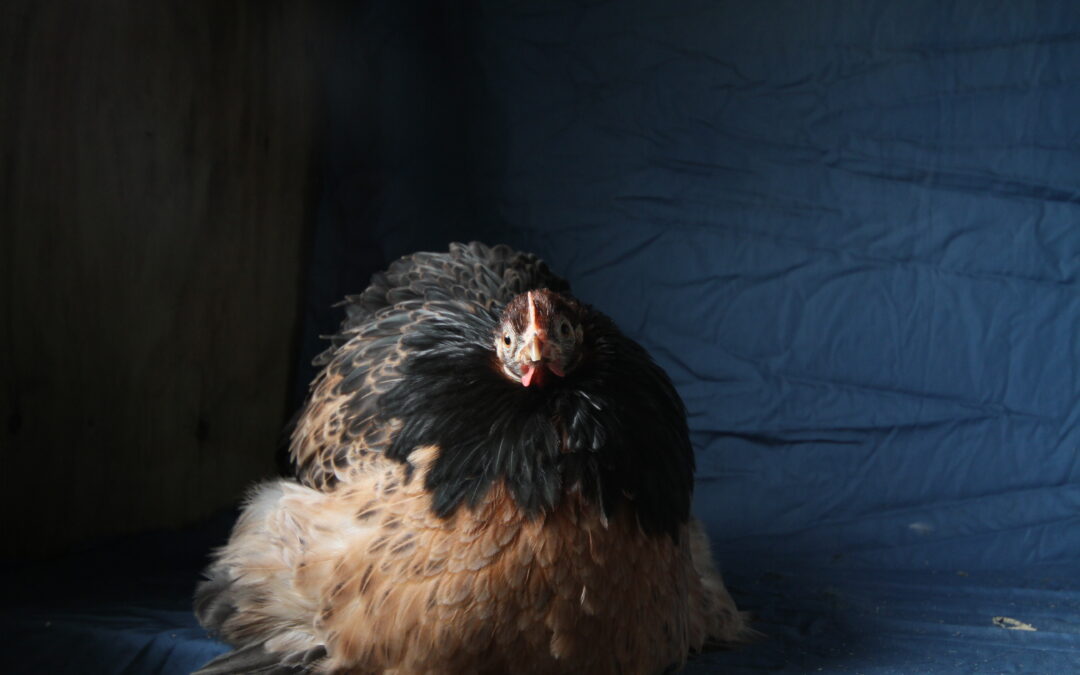
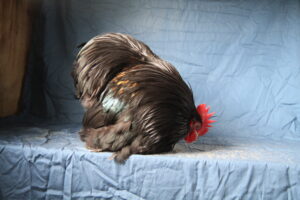
Here are some photos of brassy back pekins:
The furnace
This is by far the most popular colour, but it’s often confused with brassy backs. This is duckwing in colour, meaning the wing bay is a different colour to the body and rest of wing; what I find interesting is the furnace OEG bantam is quite a bit different to the furnace OEG fowl and furnace Leghorn.
The following is quoted from the New Zealand Poultry Standards third edition (2013):
Leghorn: Male; “neck, hackle, and saddle; red or gold streaked with black, back and shoulders; red or gold, breast and thighs; sooty black. Wing bow; red or gold with a rich dark blue bar across. Secondaries; bay colour mixed with grey. Primaries; black.”
Female; “neck and hackles; gold streaked with black. breast and thighs; deep salmon colour. Back and wings; sooty-black mixed with a little gold colour, with each feather having a light quill. Tail; black.”
Old English Game Fowl: Male; “neck, hackle, and saddle; red or gold streaked with black, back and shoulders; red or gold, breast and thighs; sooty black. Wing bow; red or gold with a rich dark blue bar across. Secondaries; bay colour mixed with grey. Primaries; black.”
Female; “neck and hackles; gold streaked with black. breast and thighs; deep salmon colour. Back and wings; sooty-black mixed with a little gold colour, with each feather having a light quill. Tail; black.”
Old English Game Bantam: Male; “black, with brassy wing butts, wing bay, saddle hangers. Brassiness to be allowed in hackles and on back.”
Female: “Black with salmon breast. Brassiness allowed on wings, back and hackle.”
As you can see, the furnace is quite a bit different to the brassy back. The furnace male has colour in his wing bay (secondaries), whereas the brassy back does not, and the furnace female has a salmon breast, whereas the brassy back has a fawn breast.
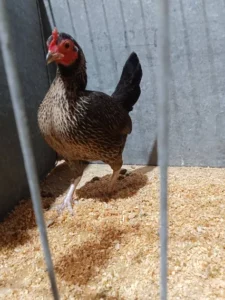
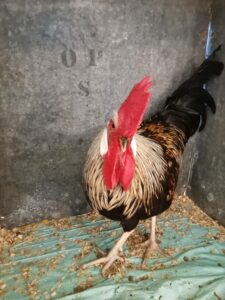
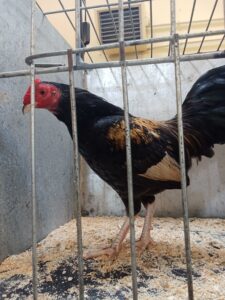
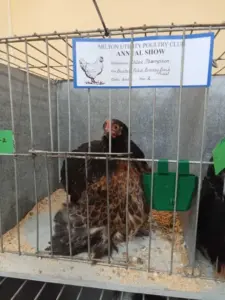
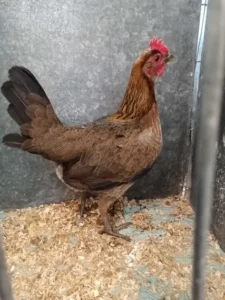
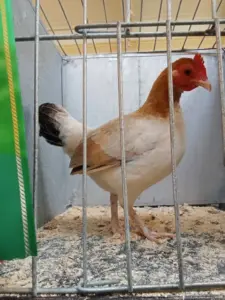
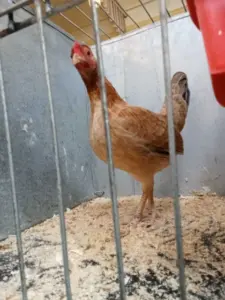
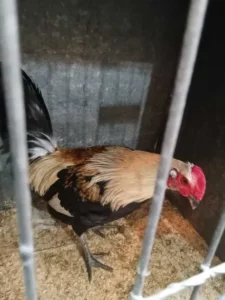
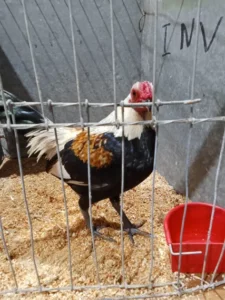
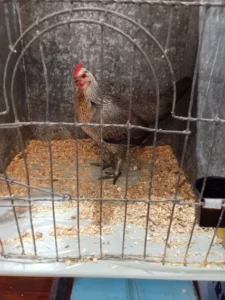
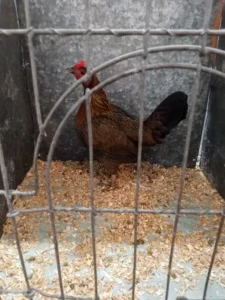
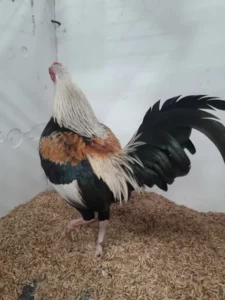
Here is a furnace Old English Game Bantam female, furnace Old English Game Bantam male, over-melanized furnace Pekin, and a furnace Leghorn male:
The polecat
This is the least popular variety for some reason; I often see these being called brassy back, especially amongst pekin fanciers. These are very similar to furnaces in most respects, but there are some key differences.
The following is quoted from the New Zealand Poultry Standards third edition (2013):
Old English Game Fowl: male; “hackle; black with tan striping. Breast; black. Back; tan or brass coloured. Wing bow; tan or brass coloured. Wing bar; black. Wing bay; tan. Tail; black.”
Female: “similar to furnace except somewhat lighter in colour with more brown in hackles.”
Old English Game Bantam: male; “hackle; black with tan striping. Breast; black. Back; tan or brass coloured. Wing bow; tan or brass coloured. Wing bar; black. Wing bay; tan. Tail; black.”
Female: “similar to furnace except somewhat lighter in colour with more brown in hackles.”
So here you can see that the polecat is quite a well-defined colour, with both standards being identical. The polecat male is a black bird with tan or brass in the neck (striping), back, wing bow, and wing bay; the polecat female is just like the furnace but with more brown in her neck, and a lighter colour.
Here are some photos of polecat OEG bantams:
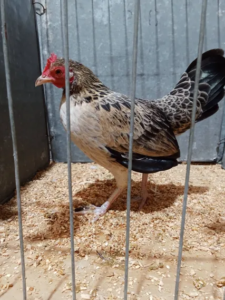
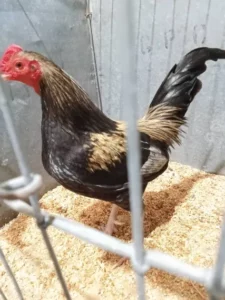
(The male here could almost be considered a furnace if he had less tan in his neck hackles)
And here is a polecat pekin:
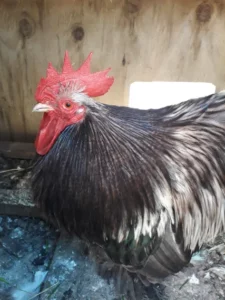
Genotype
Although all three colours are clearly different, and even different strains within each variety may have subtle differences in genotype, we can confidently say that all three are heavily melanized. Please keep in mind I have only ever worked with one strain of the brassy back colour; the rest is purely taken from research I have done.
Before we go into the genotype of the brassy back, furness, and polecat family, we must understand how colours are made up. I will give a brief explanation here, but I will write a more in-depth article on this topic soon.
Before I even begin to explain how colour varieties are made up, you must understand what they are made up of.
In chickens, every colour found in their plumage is made up of two forms of melanin: eumelanin and pheomelanin.
Eumelanin is the black pigment, and pheomelanin is the red pigment.
From there, you have modifying genes that change the colour; some can completely remove the pigment, creating white, whilst others can intensify it to the deepest reds as found in exhibition Rhode Islands.
Every gene has a unique effect on the melanins.
The ‘e’ alleles
An allele is like one special version of a gene — think of genes as instructions, and alleles as slightly different ways those instructions can be written.
In chickens, the e allele (often written as lowercase “e” like e⁺, eᵇ, or others) is one version of a gene that helps decide feather colors and patterns. It controls how much black or red/gold shows up on the chicken (like making stripes, spots, or mostly one color). Different “e” versions make different looks — some let more red show, while others add more black!
For example: A chicken with certain e alleles might look wild and colorful like a jungle fowl, while others look darker or patterned.
E alleles do not change the colour, but the distribution of the eumelanin and pheomelanin across the body.
We definitely find more variation amongst the females than in the males; the order of dominance is (most recessive to most dominant)
eb (brown)
e+ (duckwing)
eWh (wheaton)
ER (birchen)
E (extended black)
In this article, we are only going to look at e+(brown) and eWh (wheaton) as I feel they are most likely to be what this family is based on. However, it’s not impossible for it to be on eb, but a bird of this colour would not properly meet the standard and would likely be almost black.
e+
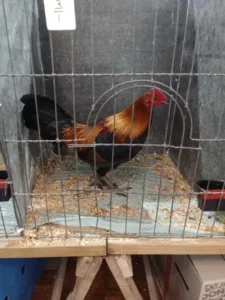
A pair of red duckwing (black-breasted red/partridge) Old English Game fowl.
This is the “wild type” colour, although we now know that it’s not the only wild type e allele, as science has shown us that there was more than one jungle fowl that went into the fowl we have today; in fact, all breeds have genes that can be traced back to each of the jungle fowl species.
The male’s plumage is mostly coloured with eumelanin (black), with pheomelanin (red) in his neck hackles, saddle hackles, back, shoulders, and wing flights. The female’s plumage is mostly coloured with pheomelanin, with both eumelanin and pheomelanin in the back and wing feathers creating a stippling effect, with eumelanin in the tail; both sexes have varying degrees of eumelanin in the hackles in the form of hackle striping.
eWh
Two wheaten Old English Game Bantam hens showing some of the vareations within the wheaten colour, most brassy birds are based on a wheaten simmilar to the darker of the two.
This is pretty much the same as e+ except that in the hen the whole body except the tail and parts of the flights is colored with pheomelanin, the flights and tail is colored with eumelanin, although both sexes usually lack the hackle striping.
Gene list
This will be an important reference for creating a strain of this family, whilst this isn’t a complete list, it is a list of the most important genes you need to be aware of when breeding these colours.
I have added photos of how some of these genes affect the plumage colour where currently possible. genes that do not currently have photos to go along with them will get photos when I eventually find birds that are good examples.
Ml – melanize is a melanizer (eumelanin) that is most effective at extending eumelanin into the upper hackles, although it does affect many areas of the plumage to some extent, it is dominant.
s+ – this is the gold or red gene, it is absolutely necessary to any proper brassy back, furnace, or polecat, however S (silver) based ones are possible (and often quite pretty), they are not correct. This is sex-linked recessive.
Left; s+/s+ BB red. Middle: s+/S yellow duckwing (note the yellow hackle colour). Right; S/S female line silver duckwing (note the silver hackle colour).
Left: S/- silver duckwing. Right; s+/- partridge (BB red).
Aph – autosomal pheomelanin, adds extra pheomelanin to the shoulder area, in turn making a darker colour: this is not required to get the brassy back, furnace, or polecat, but is often present in the genotype of these birds. The alternative gene to Aph is Aph^I.
Although the example photos here are on an S/S base, it has a very simmilar effect of s+/s+. This is dominant.
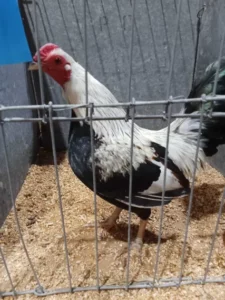
Left; Aph (female line silver ducking). Right; Aph^I (silver duckwing).
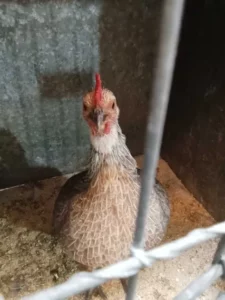
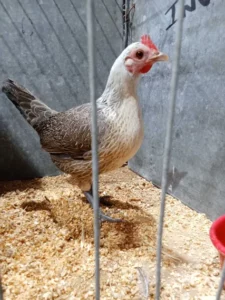
Left: Aph^I (male line silver duckwing). Right: Aph (silver duckwing).
Di – dilute is most effective at diluting pheomelanin, with no recorded effects on eumelanin. This will give you your brassy colour as opposed to red or orange: it is not required in all birds, as some are allowed red. It is dominant.
“rb” – this is not a gene as such, but a catch-all term for a group of melanizers that usually affect the lower hackles: some will also affect other areas of the plumage, although not all. They are recessive.
Cb – champagne blond is a gene which dilutes pheomelanin to an even shade of buff, whilst it’s definitely not required, it’s one of many ways of achieving the correct phenotype. It is dominant.
What do we need to add to get a brassy back, furnace, or polecat?
It is perfectly possible to create all of these colours on either e+ or eWh: however, it would be easier to create brassy back on eWh and furness on e+ as it would give the hen the right breast colour without any additive genes, I think most polecats are on eWh.
You then need to malinize the bird to get the correct level of black for your chosen colour. This is the hard part as most of the melanizer’s are yet to be identified and named, usually both Ml and two different “rb”s are required.
Although not all “rb” will give the most satisfactory results, polecat and furnace are definitely less melanized than brassy backs, and I suspect that is because of the rb factors.
Once you have a satisfactory level of melanization, you now need to perfect the pheomelanin shade by adding or taking away diluters, and generally just playing with different genes to get the required look.
Obviously it’s not as easy as I made it sound, and if you’re starting from scratch then expect this to be a long term project. Each gene may take three generations to fix, maybe even longer if you don’t properly test the potential brood fowl or hatch enough chickens.
Here’s a few basic genotypes for the brassy back, furnace, and polecat family
e+/e+ s+/s+ Aph/Aph Di/Di Ml/Ml rb/rb
e+/e+ s+/s+ Ml/M rb/rb
e+/e+ s+/s+ Aph/Aph Cb/Cb Ml/Ml
e+/e+ s+/s+ Di/Di Ml/Ml rb/rb
eWh/eWh s+/s+ Aph/Aph Di/Di Ml/Ml rb/rb
eWh/eWh s+/s+ Ml/M rb/rb
eWh/eWh s+/s+ Aph/Aph Cb/Cb Ml/Ml
eWh/eWh s+/s+ Di/Di Ml/Ml rb/rb
Although that is definitely not a complete list, and not all of the above genotypes will necessarily give satisfactory results, it certainly gives you an idea of the genotypic variations found in this family.
Breeding the brassy back, furnace and polecat.
For this you can pretty much use common sense, if your males are too black then you would breed them to a lighter female then what you were previously doing, so if your breeding dark females and your getting dark males then you obviously need to use better coloured females. However it won’t work if you breed a extremely over coloured female to an under coloured male, this will not permanently fix your problem.
Some common faults include but are not limited to: white feathers, red, yellow, or brassy feathers where it’s supposed to be black, not enough brassiness, incorrect shade of brassiness.
White feathers are a hard one to fix, it’s usually caused by progressive whitening, which I will write a whole other article about soon as it’s such a complicated trait with many problems often associated with it including loss of fertility and hatchability, and on top of that its not very well documented at all.
It can also be caused by one of the mottling genes, which can be either dominant or recessive depending on the exact gene you have, it’s usually the recessive gene ‘mo’.
It could also be vitiligo which is very similar to progressive whitening.
If you have any that aren’t expressing it then those are the ones you need to breed, otherwise you need to breed to the lowest intensity of it. If they are all the same in expression, or you have been working on getting rid of it for awhile and it’s just not getting any better. Then it’s time for an outcross to a line of birds that aren’t expressing this fault, or it’s time to scrap the strain and start over.
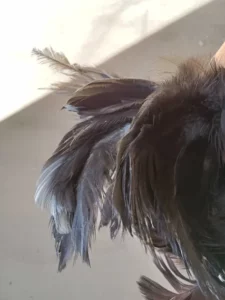
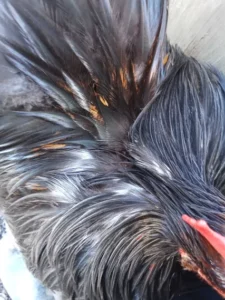
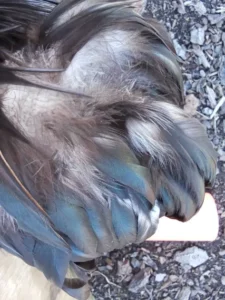
Left; white in footings. Middle; white in hackles. Right; white in tail.
Brassiness in the neck is caused by a lack of the correct melanizers.
It is not a fault in all three colours, polecats and some furnaces are required to show this trait.
In order to fix it you will need to locate a bird with the correct melanizers. Ideally this would be off your own yard, or at least a bird of the correct colour.
If you can’t find a brassy back, furnace or polecat in your breed that is properly melanized then you may need to go to a solid black bird, just be sure that there is no red, orange or yellow feathers on the bird.
Once you have bred the new bird into your line, you will begin the lengthy process of making them homozygous for all (at least 3) melanizers whilst weeding out any bad genes until you have fixed the problem.
Too much brassiness can also be fixed in a similar manner.
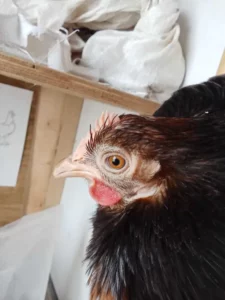
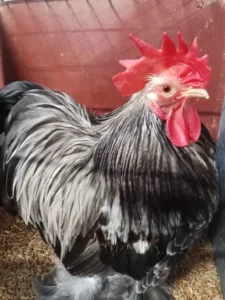
Left; brassiness on head (which is preferred in some breeds over a black head). Middle and Right; too much brassiness (not all colours).
If your birds are too black then they are over melanized, to fix this you will need to locate a brassy back, furnace or polecat that has less black then your birds (this would ideally be on your own yard). They don’t have to be too light, ideally they would be the correct balance of eumelanin and pheomelanin, however it is better too brassy then not brassy enough in this instance as your just trying to delete some of the melanizers your birds have.
If you can’t find a brassy back, furnace or polecat that is fit for this then after establishing whether your birds are wheaten based (yellow chickens) or duckwing based (chipmunk chickens) then you need to locate either a wheaten or a black breasted red/black red/wild partridge to use.
It will take several years to fix the colour to a point of homozygosity again.
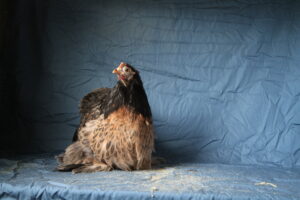
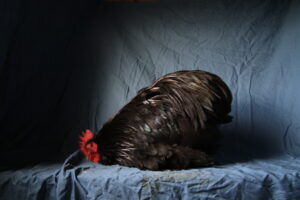
Above; birds with not enough brassy colour although the hen is close to where she should be and for some standards is acceptable.
Brassy colour that is too dark is caused by lack of diluting genes, or a presence of intensifying genes such as mahogany.
If you’re seeing variation then you just need to slowly select towards the correct shade, if not then you may need to bring in another bird.
That bird would ideally be a brassy back, furnace or polecat that is of the correct shade. But it may need to be a wheaten or black red, if you can’t find a bird of the correct shade in any of these colours then you may need to look further afield, just make sure the bird your bringing in is of the correct shade.
Brassy colour that is too light is caused by too many diluting genes, presence of the silver gene, or absence of the intensifying genes (eg; mahogany and autosomal pheomelanin), it can be fixed in a similar manner to brassy colour that is too dark.
Conclusion
Hopefully that clears things up a bit as I feel there is not a lot of readily accessible information about these birds. A lot of what I now know about this family I had to find out for myself via years of research as no one was able to give me any straight answers. Often I found it was ask 10 people 1 question and get 10 different answers.
The crazy thing is, these birds are usually just one gene away from being black, that is the e-allele that they are based on, blacks being either birchen or extended black, and brassy backs, furnace, or polecats being either wheaten or duckwing.
I hope that in the future all of what I discussed here will become common knowledge, which will in turn better the breeding, judging and exhibiting of these birds.