A lot has happened with this project since last time I wrote, overall everything is looking very promising.
I’m still hatching NZFFs. I started in September and I was admittedly hoping to be done by now, but with all the issues I have had with power cuts this season most of the chickens died in the shell.
I am putting what will probably be the last hatch into lock-down tomorrow.
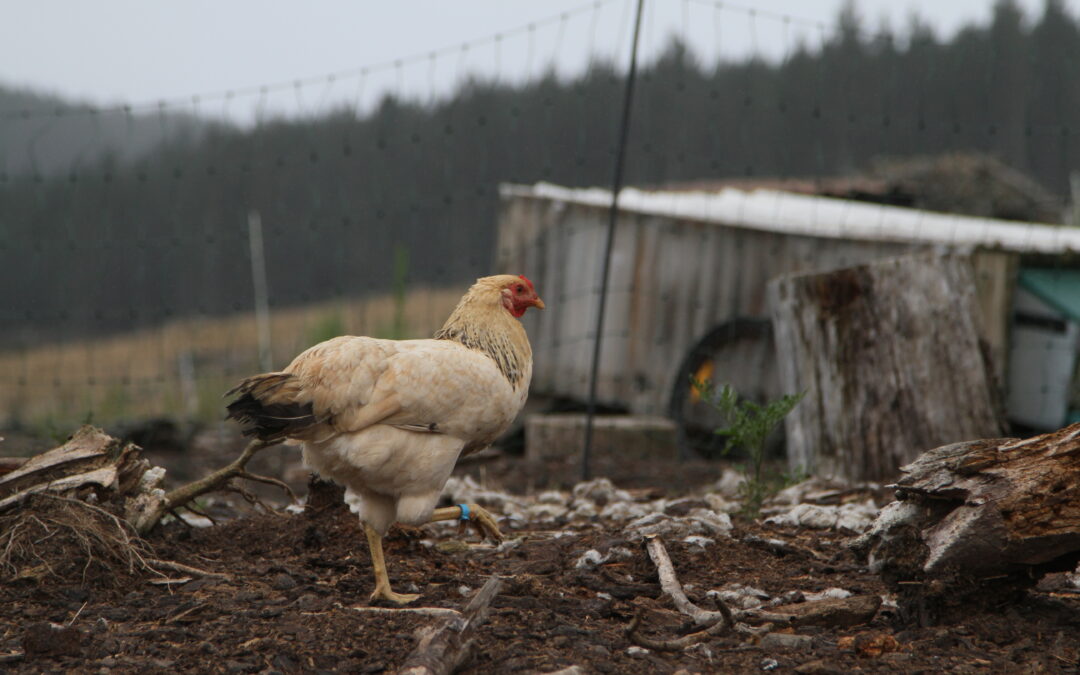
I’m really impressed with the quality of this season’s birds, their type is just amazing, they are maturing beautifully and there are a few that have near perfect colour as well.
It’s really amazing to see how quickly good type has become the norm for the breed, and comparing the pullets and cockerels of this season to the original hen and her son (both of which are retired to the laying flock) it’s really crazy how different they are.
Finally getting cockerels that are homozygous for the barring gene, from afar they almost look white in the body. Also finally getting some homozygous pea combs which can be seen by the 3 rows instead of one “fin” on top of their heads with the odd spike coming off of it, which is how the heterozygous pea combs in this breed look in my opinion.
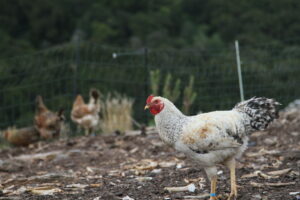
Above; a homozygous barred cockerel displaying the almost white colour.
They are coming pretty uniform in type as well, starting to look like a real breed, I just need to set colour (I will do that next season), comb type (should also happen next season), and earlobe colour, then they won’t be far from ready to be released to the public I reckon.
Definitely an improvement upon past years in every way.
Still not sure if I want to breed them red lobed or yellow lobed, either way it’s going to take some years as the birds I currently have will have yellow lobes one minute then the next they are solid red, then the next they are marbled red and yellow, so finding a bird with earlobes that remain the same colour will be a challenge.
In terms of colour all that really needs done is setting the barring which I hope to do next season by using a homozygous barred male over a barred female. Females can only have 1 copy of the barring gene and so any barred hen can be used with a homozygous (2 copies of the barring gene) bared male make the barring trait breed true.
The other thing is I am seeing a bit of variation in terms of ground colour, some a lighter creamy buff and some are a darker orange buff. Alongside that the columbian pattern needs fixed as some birds have very good colour with nice hackle striping, clean backs, and black tails, and others show little hackle striping, lots of buff in tails, and some show black all throughout the back. Having said that I am not paying very much attention to colour until after the main points of the breed have been fixed.
Combs are an easy fix, all I need to do is find a pair of homozygous pea combed birds and breed them then I basically don’t have to worry about combs until I get to perfecting the breed. Until I find a pair of homozygous pea combed birds I just have to ensure I cull any single combed birds (of which I only saw a couple of this season), and where possible I will breed homozygous pea combed birds.
Something I am seeing from the pen I bred to produce laying hens to replace my old layers is willow legs. I am still deciding if I want to start a sub-line of willow legged birds or if I just stick with the yellow. I do think it looks interesting however I’m not sure if it’s the direction I want to go.
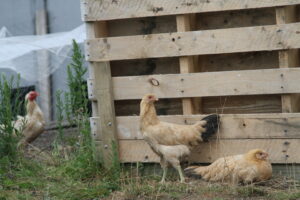
Above; a young pullet displaing the willow leg.
On the topic of sub-lines I have a couple planned outside of the possible willow leg line for next season. This season I had a hen from my laying flock go broody while free ranging and she pulled up 3 weeks later with half a dozen chickens! Only one died and it was within the first couple of days, the rest she managed to raise until they became independent and left her, now I have 5 more healthy young birds wandering around.
This was not the first time this hen has gone broody, however it was the first time I let her have eggs (not that I had any say in the matter this time). She did her job very well and always put herself between any possible threats and her chickens.
Needless to say she will be getting a place in the breeding pens next season as I will be starting a sub-line with her to work on broodiness.
The other sub-line I am considering is one using a pullet that I accidentally hatched. My sister gave me the eggs thinking they were from her silkies, but they were from the mixed laying flock.
The pullet is black barred (similar to that of a Barred Plymouth Rock but with brown leakage), pea-combed, and very friendly.
The pea-comb narrows down her mother to 3 possible birds, one of which is the hen I used to start the breed.
Her father is distantly related to the main line, he is a son of the cock I used to bring in the barring gene into the breed.
The reason I would start a subline with her is because the main line is very flighty and has a tendency to scream when held.
I would definitely like to get them at least a little friendlier which I could do with this pullet.
On another note I took a pair of NZFF to the taieri A&P show this year, it was my first time showing this breed, I didn’t expect them to do much as the pullet was rather young and the cock was about to go into a moult, the pullet got a 3rd, and the cock got a 1st (I believe he was the only bird in his class). It was a lot of fun and it was good to finally be able to show these birds and see them in the show pen next to other breeds.
It was a bit disappointing though, the cock that better represented the breed of the two that I was considering taking decided that it would be a great idea to completely ruin his tail the day after I heard there was a “backyard special” section, so I had to take his father instead.
I’m glad to say that they are also uniform when it comes to their moult, last year’s hens all started moulting at the same time, they are going through a pretty quick moult.
Their mother usually starts moulting in April and is done by May which is insanely quick.
Although last year’s hens have not yet finished moulting they are not far off which would make them also very fast moulters.
The cocks are also well on their way with the moult. They started at the same time as the hens although I imagine they will take a fair bit longer to finish due to their extra feather.
So as you can see the NZFFs are coming along nicely, and a lot faster than I expected, they still have a long way to go before they can become an “official” breed.