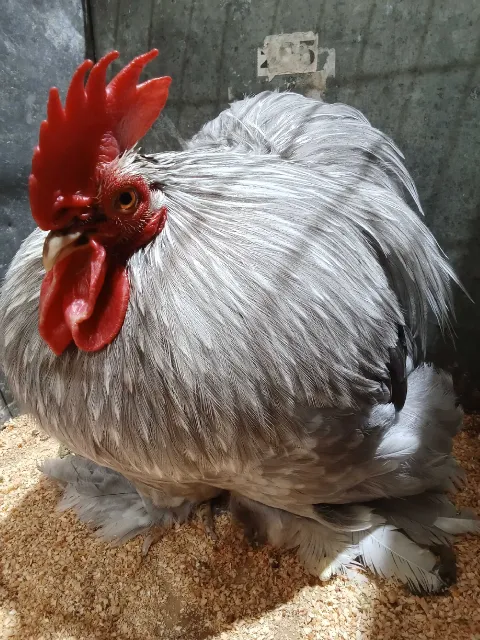
The lavender mottled is a very beautiful, delicate colour pattern, but have you ever wondered what goes into the genetic makeup of these beautiful birds? What is the best way to go about breeding and selecting them? How to get them onto champions row? Today I will answer these questions, and much, much more.
This is part 2 of an article I wrote for the SI Pekin Bantam Fanciers newsletter about lavender-mottled Pekins. Part 1 covered the basic genetics of the lavender mottled as well as tips for breeding better lavender mottled Pekins; this article (part 2) is more geared towards taking the colour apart gene by gene and looking at the colour from an all-breeds standpoint.
Genetics of the lavender mottled
The lavender mottled is really just a black bird with the lavender and mottled genes added in.
Before I even begin to explain how the lavender mottled is made, you must understand what pigments all colours of chicken are made up of. In chickens every colour found in their plumage is made up of two forms of melanin; eumelanin and pheomelanin, eumelanin is the black pigment, and pheomelanin is the red pigment, from there you have modifying genes that change the colour, some can completely remove the pigment creating white, whilst others can intensify it too the deepest reds as found in exhibition rhode islands, every gene has a unique effect on the melanins.
The e allele
The e allele is basically the canvas on which the paint or other genes are added; they decide where the eumelanin and pheomelanin are on the bird.
There are 5 main e alleles in chickens: eb (brown), e+ (duckwing), eWh (wheaten), E (extended black), and ER (birchen), eb being the least dominant and ER being the most.
Lavender mottles are usually made on either E or ER, which both look the same for the most part except that E usually is just black with colour in the hackles, and maybe a little bit on the breast, and ER being the same but with lots of colour on the breast usually in the form of lacing.
The s allele
This allele determines whether the pheomelanin is going to be the usual reds, oranges and yellows (gold), or if they are going to be diluted to the point of being white (silver).
They can be either S (silver) or s+ (gold), as ideally all that would be hidden by the melanizers.
Melanizers
To get a completely black bird, you will need at least three melanizers: Ml and at least two of the “rb”s; both of these melanizers extend the eumelanin into the areas where the pheomelanin would usually be, making a bird that usually would be black and gold or silver into a bird that is just black.
Ml – melanize is a melanizer that is most effective at extending eumelanin into the upper hackles; although it does affect many areas of the plumage to some extent, it is dominant.
“rb” – this is not a gene as such, but a catch-all term for a group of melanizers that usually affect the lower hackles; some will also affect other areas of the plumage, although not all. They are recessive.
Now to make a lavender mottled
Now that you have a black bird, it’s time to add the lavender gene and the mottling gene. The lavender gene makes the bird a purpley silvery grey, and the mottling gene adds the spots.
lav – the lavender gene, this is closely linked to the feather shredder gene, however as with any linked gene it is still possible to breed lavenders that don’t need blacks (a technique used to suppress the expression of the feather shredder gene) bred into them ever, this is because whilst it usually moves with the lavender gene, it does sometimes separate, hence why we do see lavenders without the feather shredder gene as if it were completely linked every time the gene lav is homozygous so would be the feather shredder gene, there have been several lines of lavenders bred in the UK without the feather shredding gene although I haven’t heard of any cases where this has definitely been done in other countries, there is one line of lavender mottled pekins in NZ that I know of that I believe is free from the gene.
lav is a diluting gene that affects both eumelanin and pheomelanin; it dilutes eumelanin to a lavender grey, and pheomelanin to a shade of straw or light orange.
lav is recessive, meaning it needs to be homozygous (meaning both of the available copies of the gene are lav) for it to be expressed. A bird that is lav/Lav+ (Lav+ being the wild type, lack of lavender) wouldn’t express lavender; this means the lavender gene can remain hidden in a line for many years, especially if no inbreeding is done.
mo – the mottling gene, this gene removes the melanin from the tip of the feather leaving it with a white spot, ideally in the shape of a V, however this is often not the case especially in pekins who are renowned for having much more blotchy spots that are smudged in appearance, usually having patches of grey, in some really bad cases they appear more exchequer then mottled.
Mottles tend to get gayer (whiter) after each moult; however, I have personally experienced birds that remain the same colour. I have heard of lines being bred this way consistently.
mo is recessive, meaning it needs to be homozygous to express; a bird that is mo/Mo+ (Mo+ being wild type, lack of mottling) will at most have a couple of mottles; however, usually they are completely free of any mottling in their adult plumage.
The genotype for this colour would be:
E/E (or ER/ER or E/ER), S/S (or s+/s+ or S/s+), Ml/Ml, “rb”/”rb”, lav/lav, mo/mo.
Which is just the abbreviated version of the following:
Extended black or birchen, or heterozygous extended black/birchen, gold or silver, melanized, lavender, mottled.
Now you may notice that some birds are more or less mottled, some are sharper mottled, some have V-shaped spots, others have U-shaped spots, some have a mix of it all; this is because we only covered the major genes above.
The minor genes are a group of unnamed genes that basically modify how the major gene functions, although this can also be affected by the environment.
I could not say how many minor genes there are, as this is not known by anyone; however, I feel it is important to bring up, as these genes very much affect our breeding decisions. All I can really say about them is to simply select the phenotype (appearance) that is closest to what you are looking for.
On top of that, progressive whitening syndrome will affect the colour as well, making the bird have more white in the wing and tail than it should; I believe it’s often the reason for any white other than the feather tips. I believe the birds that get gayer (whiter) every year have progressive whitening syndrome, although that trait is often just dismissed by people who say it’s just a side effect of the mottling gene. I have personally experienced birds that did not display this trait, and they came from lines with little to no white in the middle portion of the tail and hackle feathers.
It’s definitely something you will want to select away from, as it is associated with health problems and fertility issues.
I will write an article on progressive white as soon as I can, as I believe it is that important, but it’s very complicated and so requires a lot more space than I can give here.
Creating a lavender mottled from scratch
The easiest way to go about this would be to breed a mottled bird to a lavender bird, but this is not always an option, so let’s explore some of the other ways you could go about developing these.
The genes you need to include in the breeding pens are the e-allele either E or ER works just fine, the melanizers Ml, and the at least two “rb”s, and the most important genes lav and mo.
Please refer to the section about genetics for an explanation of these genes.
If you are starting with birds that are not lavender, mottled (lavender or black), or black, you will have to hatch A LOT of chickens.
For example, if you crossed two birds, both heterozygotes for all genes involved, the number of lavender mottled offspring would be 1 in 4096 (statistically speaking); although it is possible to get 5 in the first 10, it’s also possible to get none even after hatching 100,000.
This is just not a viable option for most – if not all – breeders.
The better option would be to set one or two genes at a time; for example, the first year you might want to set mo, then the next year lav, then the year after that E, and so on until they are breeding true. Yes, it will take time, but the more chickens you can hatch each year, the faster you will get there.
Ideally you would keep as many genes segregating in your flock as possible so you don’t need to mess up the past work to fix another gene, this means every year you want to include birds that are at least heterozygous for lav, mo, “rb” (all required) Ml, E/ER (either one should work), this might mean you have one pen where mo is fixed, but the cock is heterozygous for lav, and both birds are silver duckwings (or any colour on eb, eWh, e+, which are the other e alleles). In another pen you might have birds that are homozygous E (or ER) and are homozygous for the “rb” genes, but the hen is heterozygous for Ml.
Using this method of segregation, you can fix the genes you want much faster, as you are much less likely to lose them by picking the wrong bird. The more genes you can get in each pair, the better, and both cock and hen can be heterozygous for each gene, or one can be homozygous and one can be heterozygous, or one can be homozygous and the other can not have the gene at all; any option works as long as you keep the gene in at least one of your matings each year.
If you’re not sure where to get these genes from, then you may find this list helpful:
lav: coronation (like in Sussex), lavender, porcelain, isabella, etc.
It is identifiable by the fact that it turns black to silvery grey, and red to orange, orange to yellow, yellow to straw, aka dilutes both pheomelanin and eumelanin.
Try to bring in from a line that is free from the feather shredder gene to make the long-term breeding of your line much easier.
mo: found in spangle (as in OEG), millie fleur, porcelain, mottled, etc.
It is identifiable by white spots at the end of feathers, often edged with a black bar.
Where possible, bring in from a line with even, sharp (usually V-shaped for most standards) mottles; also, your life is going to be way easier if they are properly mottled in the hackles – most lines either have very little white in the hackles, or they have far too much.
E: found in most lines of black-breasted birchen, black-breasted brown red, some blacks, whites, lavender, blue, splash, mottled, etc.
By itself, it spreads the eumelanin everywhere on the bird except for the neck in the females, and the neck, shoulder, back, saddle in males, also sometimes a small amount of colour on the breast.
Ideally it would be a line with no pattern on the breast.
ER: found in most lines of “pattern breasted” (lace breasted, streaky breasted, etc), brown red, and birchen, found in some blacks, whites, lavender, blue, splash, mottled, etc.
The effect is as for E but with more pattern in the breast.
Preferably a line with very little pattern on the breast.
The melanizers: I am not going to write these out individually because all may be found in the same varieties, and honestly it’s not known exactly how many there are.
They are found in all solid black fowl, also found in lavender, blue, splash, brassy back, or furnace with solid black hackle, mottled, some lines of white, etc.
Ideally, the bird would be from a line where the males show no red leakage in the hackles, as this will show up as straw in the lavender mottle (unless on a silver base, then it will show as white). Melanizers are a tricky one, as the female’s phenotype is not always indicative of her genotype. Thankfully, the male’s hackle seldom lies. In short, a male without leakage is almost always going to have the required genes; however, a female without leakage may or may not have them all.
Breeding lavender mottled
Once you get yourself at least a pair of lavender mottles (either ones that you bred from other colours yourself or ones you acquired from another breeder), you will need to work out how to properly breed them. They are a colour which is among the most troublesome to breed, especially if your line has progressive whitening syndrome or the feather shredder gene, or some other gene wasn’t set right, or the wrong variation of a gene was used.
In saying that, though, they can be really easy to breed if the genetics were set right.
The most important thing is to make sure that you keep the shade of lavender correct, and keep blues far away from your lavender mottles, as when the blue gene is paired with the lavender gene they become very pale.
What to do if your line has progressive whitening syndrome
Mottles are amongst the most difficult colours to eliminate progressive white from.
This is because progressive white often shows up as white feather tips.
It also shows up as excess white in the hackles, especially in males, and white in the tail outside of the expected white tip and some possible white under-colour.
Unfortunately, a lot of times progressive white is normalized in mottles with the excuse of it just being the way the gene works.
I believe progressive white is also at least partially responsible, if not the sole reason, for mottles getting gayer (whiter) with age. I have personally experienced birds that did not get whiter with age at all, and they didn’t have excess white in the hackles or tail.
Progressive white is an absolute pain to get rid of. It takes years of hard culling to reach a point where it’s mostly gone.
To be sure it’s totally gone, you need to wait until the possible brood fowl are as old as reasonable before breeding them, ideally around 5 years old.
After they are bred, they need to be kept around until they die to be sure they never develop any extra white.
If at any point the birds develop extra white, then you know they have progressive white.
Although it’s certainly not necessary to completely get rid of it, it’s ideal to at least push it back far enough that they don’t develop it for the first 3 or so years of their life.
I would rather have a line that has a moderate amount of white and hardly progresses than a line that has hardly any the first year, then is almost white the next. The first option is way easier to breed out, as it is way more predictable.
The actual process of breeding it out is pretty straightforward; cull hard, only breed to the ones without any; if that’s not yet an option, then only breed to the birds with the least amount of it.
Eventually you will get rid of it at least to a point where you don’t notice it until the birds are quite a bit older.
What to do about the feather shredder gene
This is one of the biggest issues in any lavender-based variety. The feather shredder gene is very closely linked to the lavender gene, and therefore is very hard – though not impossible – to separate.
First, we need to understand how gene linkage works.
Most people assume that because genes are linked, it means they are inseparable; however, this is not the case. Whilst linked genes often move together, they do separate from time to time, and once separated can be bred as individual traits.
This is very different to pleiotropy, which is when one gene is responsible for multiple traits; in the case of pleiotropy, two traits are completely inseparable.
Linked genes are linked because they are located very close together on the same chromosome, and therefore usually move as one.
They are not stuck together, just located very close. This means they can and will be separated.
Not much is known about the shredder gene; however, it is known that it is closely linked to the lavender gene. It is also likely that it is only ever seen in lavenders because of the reduced melanin in the plumage, making the feathers weaker. This would explain why it’s never seen in blacks, even though blacks and lavenders are regularly bred together.
If you wish to get rid of the feather shredder gene, then the best piece of advice I can give you is to hatch a lot of chickens and breed blacks (or, in the case of the lavender mottled, black mottleds) every so often; this will periodically bring in the counter gene that is needed to replace the feather shredder, and therefore create the envormoment required to eliminate the gene.
When you get lavenders without this gene, hatch a lot of chickens from them; if some of them come out without the feather shredder, then keep them and cull any that develop it; keep doing this until you eventually produce a line that doesn’t have it.
It can and has been done; I know of one line of lavender mottled Pekins in NZ that I am reasonably certain doesn’t have the gene, although we can’t be 100% certain for another couple of years.
Getting lavender mottleds onto champions row
This is definitely going to be one of the harder colours to get up the front; mottles in general are very hard to get on champions row, and then on top of that you also have all of the issues that often come with lavenders; poor feather quality, uneven colour, brassiness, etc.
Another major issue is that the colour is not in most, if not all, breeds’ (I haven’t actually done a thorough check through the standards, but I haven’t seen it yet) standards in NZ. This would be easy enough to fix if breeders can find a good colour standard from an international standard.
The first thing you need to get the top prizes is type; without it, you have nothing. You must study the standard of your specific breed, and you must breed for what is written within the standard. There are other things some judges look for that aren’t included in the standard; sometimes this is personal preference, drawn from another country’s standard, or simply something they have been told should be present in winning specimens.
You also need to have birds completely free from defects and disqualifications; every bird has its faults, but if your bird has a wry tail, then you can say goodbye to any chance of winning under even a half-decent judge.
Once you have these things down, then colour becomes important; in most mottled, you want a solid coloured bird-in this case lavender-with each or at least most feathers, with a crisp small white V-shaped tip at the end. The white should be evenly distributed over the whole of the bird.
Common colour faults for mottling include: smudginess or streakiness instead of a crisp, solid white V tip; overly gay plumage-that is, too much white-especially in young birds; Uneven distribution of white; this is quite common, often affecting the hackles, which either sway way too gay or are almost solid black. I have seen examples of otherwise beautifully marked birds who had practically no white in the entire wing; White in the body of the feather, white in the under colour is acceptable in many breeds, but white in the web except at the tip is considered a major fault as it leans toward exchequer instead of mottled; Mottled shanks are another common fault in yellow-legged mottled; however, it is not a fault in all breeds and is actually required in all colours of Ancona.
Common faults for lavender include: brassiness, often found on the shoulders of males; silver edging on the feathers; this one’s hard to spot at times because lavender naturally has a silver tinge to it, but this fault is quite literally white edging on feathers, often found in the hackles and back; it’s the same flaw as the brassiness but with the silver gene instead of the gold gene; feather shredding, this is often found in the tail of any lavender bird, it shows as shredded or torn looking feathers, more so than is normal; excessive dark bars, often found in the hackles, likely stress bars from what I have heard about them.
So, as you can see, it’s a very tricky colour to breed up to the standard requirements; even once you have the genetics there, it’s not easy to prepare them for show. Some things to keep in mind are keeping the fat in the feed on the higher end to help protect the feathers from damage, keep the birds out of direct sunlight as best as you can, due to the fact the feathers have less melanin in them than the average feather they get damaged by the environment very easly, if you have ever seen how sundamaged white feathers can get you will understand why you need to protect you lavender mottleds feathers, although they still need some to keep them healthy and to put nice red combs on them.
When they are moulting, they need nice high-protein (18-20%) feed with balanced amino acids and balanced vitamins to promote feather quality. Handle them as little as possible during the moult; keep them in as stress-free an environment as possible. This is to reduce the stress bars on feathers.
When it comes time to bathe them for the show, a little blueing agent as you would for a white fowl may help enhance the colour, but err on the side of caution with how much you add because you don’t want to make your lavender mottleds purple. The blueing agent will also help bring out the white tips and help to remove any yellowing that may have accrued on them due to sun or dirt.
Don’t wash them too close to the show, as they need time to preen the oils back into their feathers, or they will end up looking too dry and brittle. After a bath, give them a fair amount of fat in the feed for a day or so, just so they can replenish the oils as quickly as possible to preserve feather quality. You can either feed them black oil sunflower seeds or mix a small amount of cooking oil into the feed.
Conclusion
This variety is one of the most beautiful when done right, but can look terrible with the wrong genes, such as the feather shredder.
I really hope that more breeders take on this variety; currently, it’s only really found in Pekins, and only a handful of breeders have them.
It wouldn’t be too difficult to breed it in other breeds, especially ones that already have a variety with lavender and a variety with the mottling gene. I think it would be quite cool to see it in anconas, although you would need to find a way to bring in the lavender gene.
Lavender mottled comes with a lot of challenges, both in breeding and showing, but it’s definitely a colour worth pursuing.