This series of articles is to document the development of my meat bird project. They will be very similar to the NZFF project articles. There will likely be more focus on the landrace as a whole, rather than on individuals, which reflects how I breed and select these birds.
This line is considered a landrace, which means to say they are a line of birds selected for a handful of traits that they all share, but their other traits are allowed to vary. Although the type is pretty similar among members of this line, their colour varies a lot, as do leg colour to some degree and several other minor traits like beak shape.
They differ from a breed in that a breed has a fixed look, a certain shape that they must conform to to be considered that breed; a landrace, on the other hand, just needs its members to share a few traits such as carcass shape, fleshing, and growth rate.
I may eventually turn them into a breed; however, for the time being, that is not the goal. I just want functional meat chickens.
I started with this line in 2024; we were given a trio of commercial meat chicken X Barnevelder. They were a very good size; the male was probably around 5-5 ½ Kg, but they lacked a little in fleshing. They were very close, but their keels were just a little too prominent for what I want.
The 2024 hatching season was very poor for us, a mixture of environmental reasons, and it was our first time incubating at this house, so it took a lot of trial and error to get the humidity right.
I ended up with one nice male and a handful of nice enough females, which went in the pen with the one remaining original hen; the other died from a heart issue not long after the breeding season.
From what we did manage to hatch that year, many of them died from heart attacks or similar heart issues between 4 and 8 weeks of age. There was one very small hen, which was the first one we ate from this line.
It didn’t help that one of the 2 hens we bred this year mostly laid double-yolked eggs, which don’t hatch, and the other hen laid a lot of defective eggs with really wrinkled shells, or overly round eggs. So the number of eggs we could actually set from these hens was very limited.
In 2025, we had a much better season. Despite excessive power cuts causing the second half of the season to yield poor results, I did manage to hatch a good number, most of which we ate; there were some truly exceptional birds, most of which have been kept back; a couple got eaten for one reason or another, usually completely wrong colour or badly twisted wing feathers.
I didn’t lose a single chick to a heart attack this time, although a couple of the hens did pass away over the season.
Going into the 2026 season, I have 2 breeding pens: the brood cock from the previous season with one pullet and one hen from the previous season, and a new male who hatched last year, with three pullets.
All of which are very nice birds; the fleshing has improved significantly from where they were in 2024, and the males are almost 6 kg at mature weight.
The things we select for include:
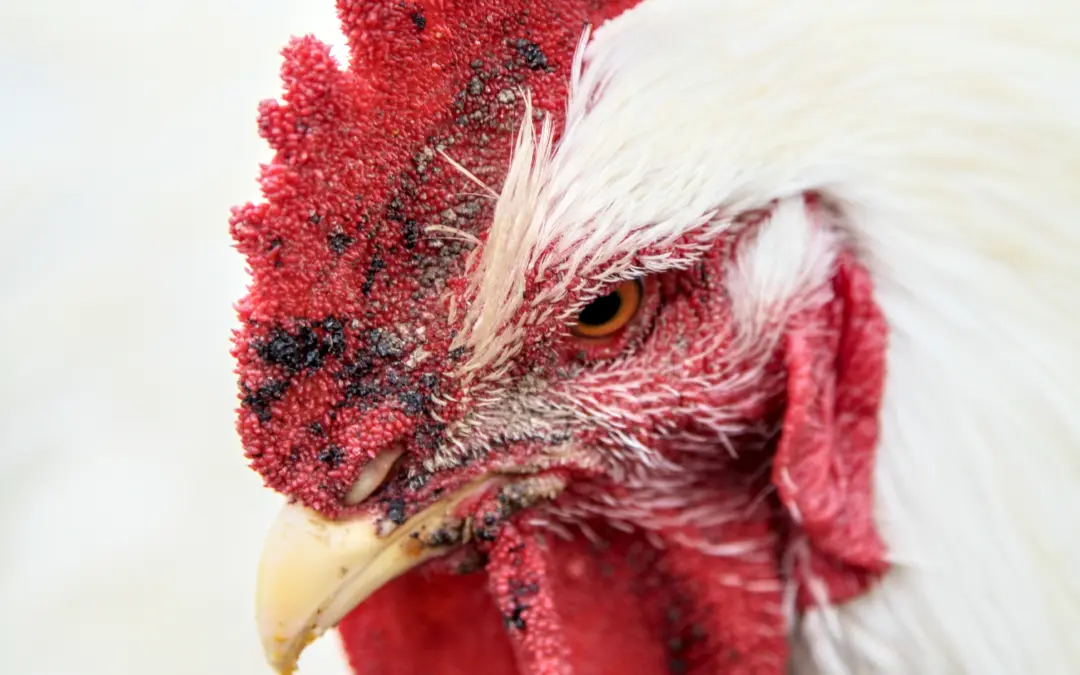
- Good health: anything that gets sick gets culled; we select for good hearts and lungs as best as we can by choosing birds whose combs stay red and don’tshade to purple, especially in the males, and that don’t wheeze when they breathe. By doing this, we have mostly eliminated the heart issues they had in the beginning.
- Good egg production: obviously these are meat chickens, so we don’t expect them to supply us with eggs year-round; however, I expect good egg production during the breeding season, and on top of that, I want good eggs: hens that consistently lay double-yolked eggs, round eggs, pointy eggs, or other defective eggs, get culled.
- Light plumage colour (some variation of white, white with brown, and white with black) because it leaves a cleaner-looking carcass; dark feathers tend to leave a bit of pigment behind when the bird is plucked if it had pin feathers at the time, which our birds do when we butcher them, so we decided to head down the white or mostly white plumage path.
- Good size: we want our males to weigh between 5 and 6 Kg by the time they are 6 months; the hens are usually between 4 and 5 Kg at this age. The key is not breeding them too big, or you will end up with leg and joint issues.
- Good fleshing: this is the most important thing to us. We want breast muscles that almost hide the keel bone, and thigh muscles that are plentiful.
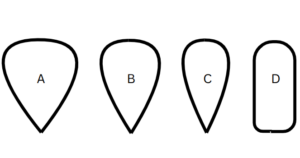
- Carcass shape: we want an almost heart-shaped breast, but not as extreme as the chicken you buy at a store. The breast should be broad at the front and taper moderately towards the end; however, the breast muscle should have no indent in it, creating a concave shape, as we have occasionally found, a defect that often develops around 5-6 months of age. The keel bone should be straight and strong. The thighs should be well fleshed, the lower thigh not being too long. We also want the body to be relatively deep, which makes butchering them easier and also allows more space for organs. Below is an example of some carcass shapes; A is a little too broad at the front, much like a store-bought chicken. This type of chicken tends to walk with a waddling gait and is more prone to leg and joint issues, although this is an acceptable carcass shape. B is a little more on the narrow side. Depending on the age of the bird, you want a carcass somewhere between A and B. C is far too narrow. D is far too narrow and doesn’t have any taper; this is a very common carcass shape amongst most breeds.
- Good fertility and hatchability: this is another very important point and is something that needs to be watched closely with such heavy-set birds. Making sure the legs don’t get too short in the males will help prevent poor fertility, and only breeding hens whose eggs have high hatch rates will keep the hatchability from disappearing.
- Defects such as: twisted wing feathers, crooked keel, wry tail, in-knee, bow-leg, duck-toe, roach back, and any other structural defects. Thankfully, most of those we have yet to run into, but twisted wing feathers are a prevalent issue. For those who have never seen a bird with twisted wing feathers, they are feathers where the rachis, that is the center bit of the feather that the web attaches to, is twisted, which makes the feather look like something that should be found on a Sebastopol goose.
So far, we have butchered most of our meat birds at 14 weeks old; they averaged 1.5 kg dressed-out weight (that is, the 2025 hatched birds). The smallest was 1 kg dressed-out weight, and the largest were almost 2 kg. At this age, the meat has had enough time to develop some flavor, but not long enough to go tough. Although they definitely aren’t quite as tender as store-bought chicken, that is to be expected, as they are so much older when butchered, but they also taste more like chicken than store-bought chicken does.
In terms of feeding them, we start them on gamebird crumble, and by 8 weeks have them weaned onto food scraps we get from local restaurants; this means we are only paying to feed them to 8 weeks; after that, they are completely free to feed.
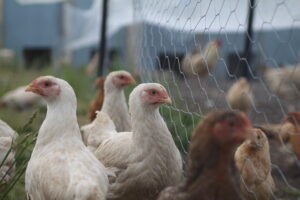
Below is a group of young 2025 hatch pullets.
I hope you have enjoyed hearing about this project. I will continue to update you whenever there is anything particularly notable happening with this landrace.